
Powder Metallurgy Duplex Synchronous Chain Sprocket

Duplex Synchronous Chain Sprocket: Precision Powder Metallurgy Manufacturing for Reliable Power Transmission
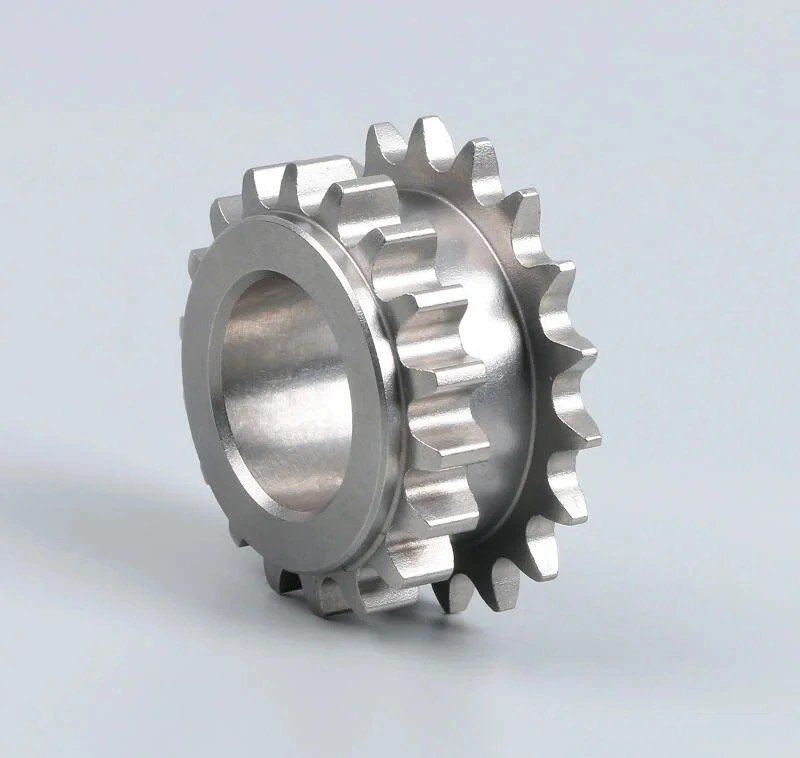
A duplex synchronous chain sprocket is a specialized power transmission component designed to work with two rows of roller chains simultaneously. By integrating two sprocket sections into a single component, it provides synchronized power transmission while maintaining a compact and reliable mechanical structure.
This duplex sprocket is manufactured using powder metallurgy, a cost-effective manufacturing process that is particularly suitable for producing high-volume precision metal components with complex profiles and consistent dimensions.
What Is a Duplex Synchronous Chain Sprocket?
Unlike a standard single-row chain sprocket, a duplex sprocket has two sets of teeth arranged on the same axis. The two rows of teeth engage with two parallel chains, allowing torque and motion to be transmitted through multiple chain paths.
This configuration is commonly used where higher load capacity, synchronized movement, or additional transmission stability is required.
Typical applications include:
- Industrial conveyor systems
- Material handling equipment
- Agricultural machinery
- Packaging machinery
- Automation equipment
- Power transmission systems
- Mechanical drive assemblies
Powder Metallurgy Manufacturing
Powder metallurgy is an efficient manufacturing technology for producing sprockets and other precision mechanical components in large quantities.
The basic production process generally includes:
Powder Mixing → Die Compaction → Green Part Inspection → Sintering → Sizing / Secondary Machining → Cleaning → Final Inspection
Metal powder is first prepared and mixed according to the required material specification. The powder is then compacted inside a precision mold under high pressure to form the required sprocket geometry.
After compaction, the green compact is sintered at a controlled temperature. During sintering, the metal particles bond together and develop the required mechanical properties.
Depending on the application, secondary operations such as sizing, machining, deburring, or surface treatment can be added to achieve tighter dimensional tolerances and specific performance requirements.
Advantages of Powder Metallurgy Sprockets
1. Consistent Production Quality
The use of precision tooling allows the sprocket profile to be reproduced consistently from one production batch to another. This is especially important for chain engagement and synchronized transmission.
2. Suitable for Complex Geometries
Powder metallurgy can produce shapes that would require considerably more machining when manufactured from conventional bar stock.
For a duplex sprocket, the integrated structure and multiple tooth profiles can be efficiently formed during the compaction process.
3. High Production Efficiency
Once the tooling has been developed, powder metallurgy is highly suitable for medium- and high-volume production. The process can reduce machining time and material waste compared with manufacturing the entire component from solid steel.
4. Material Utilization
Because the component is formed close to its final geometry, powder metallurgy can achieve efficient material utilization. This helps reduce material waste and manufacturing costs in mass production.
5. Integrated Duplex Design
The two sprocket sections are manufactured as one integrated component, providing a compact solution for applications using two parallel chains.
Designed for Synchronized Chain Transmission
The accuracy of sprocket tooth geometry is important for smooth chain engagement. For duplex applications, the relative position of the two sprocket rows is also critical because both chains need to operate together.
Proper tooth alignment and dimensional control help reduce:
- Chain vibration
- Uneven chain loading
- Premature tooth wear
- Transmission noise
- Chain disengagement
For this reason, powder metallurgy combined with appropriate sizing and secondary machining can provide an effective solution for precision chain transmission components.
Custom Powder Metallurgy Sprocket Manufacturing
Different machines require different sprocket specifications. Tooth number, pitch, bore diameter, overall width, hub dimensions, material, hardness, and surface treatment can all be customized according to the customer’s requirements.
We can manufacture powder metallurgy sprockets according to:
- Customer drawings
- 2D CAD files
- 3D models
- Existing samples
- Customized dimensional specifications
Secondary machining can also be used where tighter tolerances or specific functional surfaces are required.
Quality Control
For transmission components such as duplex sprockets, dimensional accuracy is essential. During production, key dimensions can be inspected to ensure consistency between batches.
Depending on the customer’s requirements, inspection may include:
- Tooth profile and tooth count
- Bore diameter
- Overall dimensions
- Concentricity
- Parallelism
- Surface condition
- Hardness
- Material properties
Quality control is carried out throughout the production process, from compacting and sintering to final inspection.
Why Choose Powder Metallurgy for Chain Sprockets?
For large-volume production, powder metallurgy provides an attractive balance between manufacturing efficiency, dimensional consistency, material utilization, and cost.
Compared with machining a sprocket entirely from solid material, powder metallurgy can significantly reduce material removal and machining requirements. It is particularly advantageous when the component has a repeatable geometry and the annual production volume is sufficiently high to justify precision tooling.
For manufacturers and distributors looking for a reliable source of customized chain transmission components, powder metallurgy offers a practical solution for producing duplex sprockets in consistent production batches.
Conclusion
This duplex synchronous chain sprocket combines a compact double-row design with the advantages of powder metallurgy manufacturing. Its integrated structure is suitable for mechanical systems requiring synchronized chain transmission, while precision tooling and controlled sintering help maintain consistent production quality.
With customized materials, dimensions, tooth configurations, and secondary machining options, powder metallurgy duplex sprockets can be developed to meet a wide range of industrial power transmission requirements.
Looking for a customized powder metallurgy duplex sprocket? Contact us with your drawing, sample, or technical specifications to discuss your requirements.