
Powder Metallurgy Timing Pulley: Precision, Lightweight Design and Cost-Effective Production

Timing pulleys are essential transmission components used to transfer rotational motion accurately between shafts through a timing belt. For applications requiring reliable synchronization, consistent dimensions, lightweight construction, and efficient mass production, powder metallurgy timing pulleys offer an attractive manufacturing solution.
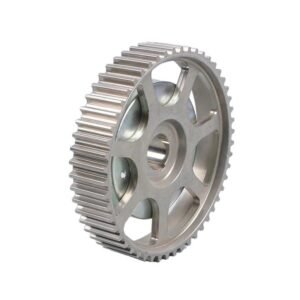
The timing pulley shown below is manufactured using powder metallurgy technology, combining a precisely formed toothed profile with a lightweight structural design. This type of component can be used in various mechanical transmission systems, including automotive components, industrial machinery, automation equipment, and other belt-driven applications.
What Is a Powder Metallurgy Timing Pulley?
A powder metallurgy timing pulley is a toothed pulley manufactured from metal powder rather than being produced entirely through conventional machining.
During powder metallurgy production, carefully prepared metal powder is compacted inside a precision die to form the required geometry. The compacted part is then sintered at a controlled temperature, allowing the particles to bond and develop the required mechanical properties.
Depending on the application, additional operations such as sizing, machining, heat treatment, surface finishing, or other secondary processes can be applied to achieve the required dimensional accuracy and performance.
This manufacturing method is particularly suitable for timing pulleys because the toothed geometry and structural features can be incorporated directly into the forming process.
Why Use Powder Metallurgy for Timing Pulleys?
1. Complex Geometry Can Be Formed Efficiently
The pulley shown in the image features a relatively complex structure, including the toothed outer circumference, central bore, raised hub area, and lightweight internal openings.
Powder metallurgy can form many of these features in a single compacting operation. This reduces the amount of material that needs to be removed compared with manufacturing the entire component from a solid metal blank.
2. Lightweight Structural Design
The internal openings of this timing pulley reduce unnecessary material while maintaining the basic structural framework of the component.
A lighter pulley can help reduce rotational inertia, which may be beneficial in applications where the transmission system requires rapid acceleration and deceleration.
The lightweight design can also contribute to material savings during production.
3. Consistent Tooth Geometry
The tooth profile is one of the most important features of a timing pulley because it must work correctly with the corresponding timing belt.
Powder metallurgy uses dedicated tooling to form the pulley geometry repeatedly. With appropriate tooling design and process control, manufacturers can achieve good consistency from part to part, making the process suitable for large-volume production.
4. High Material Utilization
Conventional machining often starts with a larger metal blank and removes material to create the final pulley shape.
Powder metallurgy is different. The metal powder is compacted close to the required geometry before sintering, which can significantly reduce machining waste.
This is one of the major advantages of powder metallurgy for high-volume production.
5. Suitable for High-Volume Manufacturing
Once the forming tooling has been developed, powder metallurgy can produce large quantities of components with consistent geometry.
For manufacturers requiring thousands or even millions of transmission components, this production method can provide an efficient balance between tooling investment, production efficiency, material utilization, and component consistency.
Powder Metallurgy Manufacturing Process
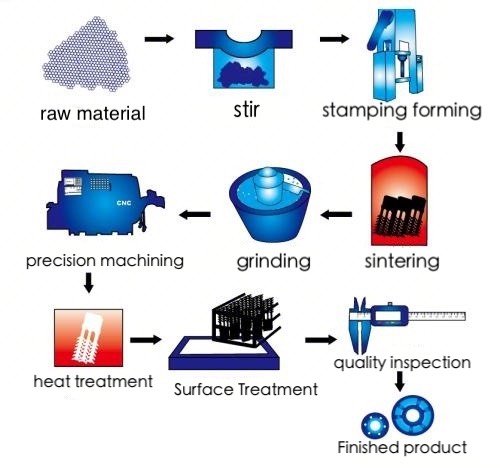
A typical powder metallurgy timing pulley production process can include the following stages:
Powder Preparation → Mixing → Compaction → Sintering → Sizing / Secondary Machining → Surface Treatment → Inspection → Packaging
Powder Preparation
The appropriate metal powder is selected according to the required mechanical and application requirements.
Different powder formulations can be developed to achieve different combinations of strength, hardness, dimensional stability, and other properties.
Precision Compaction
The prepared powder is filled into a specially designed mold and compressed under high pressure.
The tooling determines important features of the final component, including the tooth geometry, hub, bore, internal openings, and overall profile.
Sintering
After compaction, the green compact is heated in a controlled atmosphere.
During sintering, the individual powder particles bond together, increasing the strength and integrity of the component.
Secondary Operations
Depending on the customer’s requirements, additional operations may be performed after sintering.
These can include:
- Sizing
- Bore machining
- Turning
- Drilling
- Tooth finishing
- Heat treatment
- Surface treatment
- Deburring
- Dimensional inspection
The specific process depends on the required tolerances, mechanical properties, surface condition, and application.
Powder Metallurgy vs. Conventional Machining
For some timing pulley applications, conventional machining remains an excellent manufacturing method. However, powder metallurgy can provide significant advantages when production volumes are high and the component contains complex geometry.
| Feature | Powder Metallurgy | Conventional Machining |
|---|---|---|
| Material utilization | High | More material removal |
| Complex geometry | Very suitable | Possible but may require multiple operations |
| Mass production | Excellent | Suitable |
| Tooling investment | Higher initial tooling cost | Lower initial tooling cost |
| Unit cost at high volume | Competitive | Can be higher |
| Lightweight structures | Suitable | Requires additional machining |
| Dimensional consistency | High with controlled process | High with appropriate machining |
The best manufacturing process depends on factors such as annual production volume, material, dimensions, tolerances, tooth profile, mechanical requirements, and overall component design.
Applications of Powder Metallurgy Timing Pulleys
Powder metallurgy timing pulleys can be used in a wide range of mechanical transmission systems, including:
- Automotive components
- Engine timing systems
- Industrial machinery
- Factory automation
- Robotics
- Conveyor systems
- Packaging machinery
- Textile machinery
- Office equipment
- Small mechanical drives
- Power transmission systems
The exact application depends on the pulley material, tooth profile, dimensions, mechanical properties, and operating conditions.
Custom Powder Metallurgy Timing Pulleys
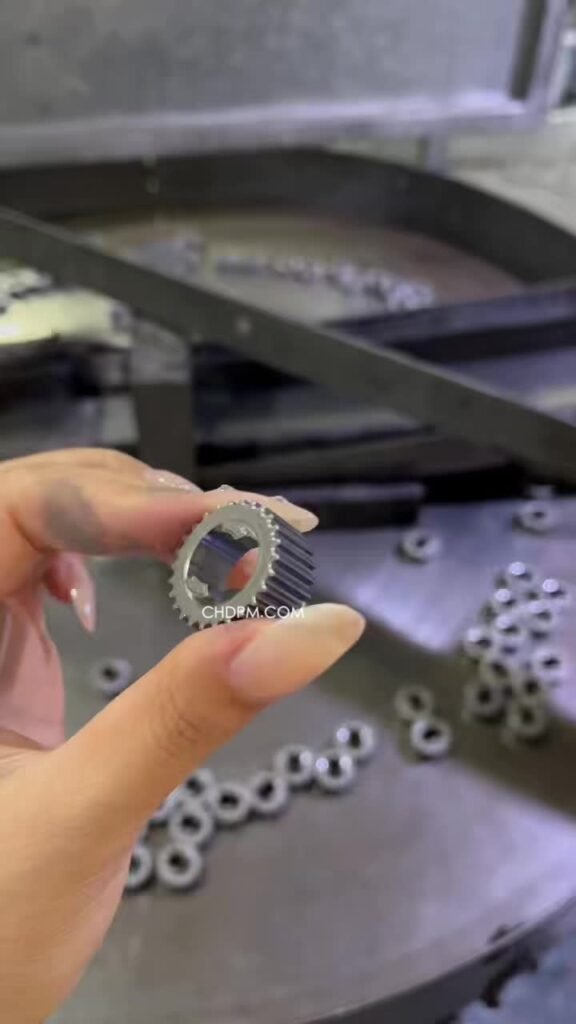
For OEM and industrial applications, timing pulleys are often designed specifically for the customer’s transmission system.
A custom powder metallurgy timing pulley can be developed according to requirements such as:
- Number of teeth
- Timing belt profile
- Outside diameter
- Bore diameter
- Hub dimensions
- Pulley width
- Material specification
- Density and mechanical properties
- Heat treatment requirements
- Surface treatment
- Dimensional tolerances
- Annual production quantity
Our engineering team can evaluate the component design and determine whether powder metallurgy is an appropriate manufacturing solution.
Why Choose Powder Metallurgy for Your Timing Pulley?
The combination of near-net-shape forming, high material utilization, repeatable production, and complex geometric capability makes powder metallurgy an attractive option for many timing pulley applications.
For high-volume OEM production, converting a conventionally machined component to a powder metallurgy design can potentially reduce machining operations, material waste, and production time while maintaining the functional requirements of the component.
The key is to design the pulley specifically for the powder metallurgy process rather than simply reproducing a machined component.
Conclusion
This powder metallurgy timing pulley demonstrates how powder metallurgy can combine precision transmission geometry with lightweight structural design.
For manufacturers looking for a reliable solution for high-volume production of timing pulleys, powder metallurgy can offer advantages in material utilization, production efficiency, geometric flexibility, and component consistency.
If you are developing a new timing pulley or looking to optimize an existing machined pulley for mass production, powder metallurgy may be a cost-effective alternative worth evaluating.
Contact us with your drawing, 3D model, sample, or technical requirements. Our team can assess the design and recommend a suitable powder metallurgy manufacturing process for your application.