
Powder Metallurgy vs MIM: Key Differences

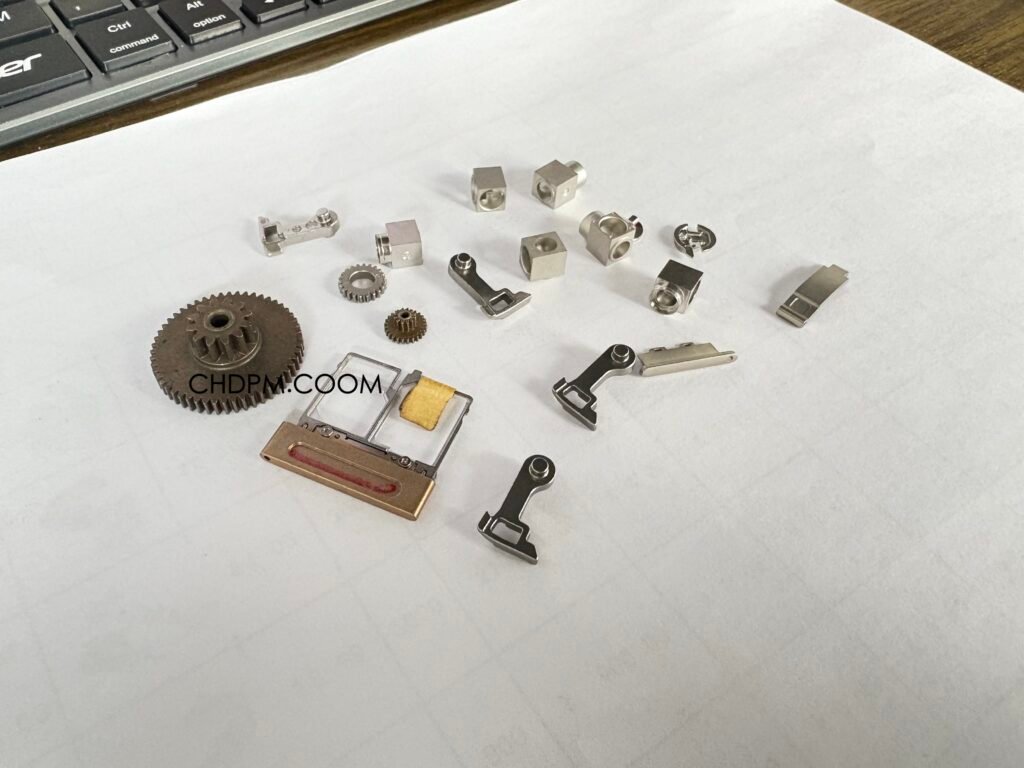
Powder metallurgy (PM) and metal injection molding (MIM) are two important manufacturing technologies used to produce precision metal components. Both processes use metal powders and sintering, but they differ significantly in forming methods, design flexibility, production economics, and suitable applications.
For manufacturers, product designers, and purchasing professionals, understanding powder metallurgy vs MIM is essential when selecting the right process for a new component.
From gears and bushings to miniature mechanical parts and complex electronic components, each technology offers distinct advantages. The best choice depends on component geometry, material requirements, dimensional tolerances, production volume, and total manufacturing cost.
1. What Is Powder Metallurgy (PM)?
Powder metallurgy is a manufacturing process that converts metal powders into solid metal components through powder preparation, compaction, and sintering.
In conventional press-and-sinter powder metallurgy, metal powder is placed into a die and compressed under high pressure to form a green compact. The compact is then heated in a controlled atmosphere to bond the particles and develop the required mechanical properties.
Depending on the application, secondary operations such as sizing, machining, heat treatment, impregnation, or surface finishing may also be required.
Advantages of Powder Metallurgy
Efficient mass production: Suitable for producing large quantities of repeatable components.
High material utilization: Reduces material waste compared with many subtractive manufacturing processes.
Complex gear geometries: Well suited to many gear profiles, sprockets, bushings, and structural components.
Controlled porosity: Can be used to manufacture porous components, including oil-impregnated sintered bushings.
Competitive unit costs: Particularly attractive when production volumes justify dedicated tooling.
Typical Powder Metallurgy Applications
Conventional PM is widely used in automotive components, industrial machinery, power tools, gears, bearings, oil-impregnated bushings, and other structural metal parts.
Its principal limitation is that conventional uniaxial compaction generally favors geometries that can be formed and released along the pressing direction. Certain undercuts, side features, and intricate three-dimensional shapes may require more complex tooling or additional manufacturing operations.
2.What Is Metal Injection Molding (MIM)?
Metal injection molding is a powder-based manufacturing process that combines fine metal powders with a polymer binder to create a moldable feedstock.
The feedstock is injected into a precision mold, similar to the way plastic components are injection molded. After molding, the binder is removed through debinding, and the remaining metal powder is sintered at high temperature to form a dense metal component.
Additional operations may be used when a component requires tighter tolerances, special surface finishes, or specific mechanical properties.
Advantages of MIM
Complex three-dimensional geometries: Produces intricate shapes that may be difficult or expensive to manufacture using conventional PM or CNC machining.
Miniature precision components: Particularly suitable for small parts with detailed features.
High-volume production: Multi-cavity molds can produce large quantities of consistent components.
Material versatility: Depending on the feedstock and process, MIM can produce stainless steel, low-alloy steel, and other suitable metal alloys.
Reduced machining requirements: Near-net-shape forming can minimize the need for extensive material removal.
Typical MIM Applications
MIM is used in medical devices, automotive mechanisms, electronic products, consumer electronics, precision locks, miniature gears, connectors, and other components that combine complex geometry with high production volumes.
Although MIM offers substantial design flexibility, it requires specialized tooling, feedstock preparation, debinding, and sintering expertise. Tooling investment and process development must therefore be considered when evaluating its overall cost.
3.Powder Metallurgy vs MIM: Key Differences
Although both technologies use metal powders and sintering, their forming methods create different manufacturing capabilities.
| Comparison | Conventional PM | MIM |
|---|---|---|
| Forming method | Powder compaction in a die | Injection molding of powder-binder feedstock |
| Design flexibility | Best for shapes suited to pressing direction | Better for intricate three-dimensional shapes |
| Typical component size | Small to relatively large, depending on tooling | Commonly small and miniature precision parts |
| Tooling requirements | Compaction dies and pressing equipment | Injection molds and debinding/sintering systems |
| Material utilization | Generally high | Generally high, with some feedstock and process losses |
| Production volume | Medium to high, depending on the part | Particularly attractive for high-volume complex parts |
| Common applications | Gears, bushings, bearings, structural components | Miniature gears, complex links, brackets, and electronic components |
Neither technology is universally better. Conventional PM is often a strong choice for repeatable parts with press-friendly geometry, while MIM becomes more attractive when a component requires intricate features that would otherwise need multiple machining operations or assembled pieces.
Actual costs and tolerances depend on the material, part geometry, tooling design, sintering conditions, inspection requirements, and production volume.
4.MIM in Foldable Smartphone Hinges: The iPhone Duo Example
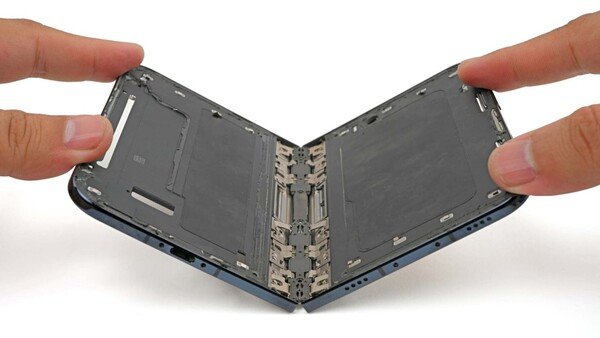
A teardown of Apple’s first foldable phone, the iPhone Duo. [Photo: iFixit]
Foldable smartphones illustrate the growing demand for compact, complex, and reliable precision metal components.
The hinge must coordinate multiple moving parts while maintaining alignment, smooth movement, and structural support. Its components may include miniature gears, links, cams, sliders, and supporting structures.
Apple’s iPhone Duo provides a useful example of advanced manufacturing in consumer electronics. According to Apple’s official product announcement, its hinge contains more than 100 components and includes a titanium hinge cover produced using metal 3D printing.
The distinction between the different manufacturing technologies is important. Metal additive manufacturing is confirmed for the titanium hinge cover, while industry reporting identifies MIM as an important process for producing complex precision components used in foldable smartphone hinges. Apple has not publicly confirmed that every internal component of the iPhone Duo hinge is manufactured using MIM.
Why Is MIM Suitable for Foldable Phone Components?
MIM can combine several detailed features into a single small metal component. This capability is valuable when designers need compact mechanisms with intricate shapes and repeatable production quality.
Potential advantages include:
Integrating multiple geometric features into one component.
Producing complex miniature links, cams, and other mechanical parts.
Supporting high-volume manufacturing with dedicated tooling.
Reducing the number of separate machining and assembly operations where the design permits.
Providing a broad selection of metal alloys for different strength, wear, and corrosion-resistance requirements.
However, MIM does not automatically eliminate all secondary machining or finishing. Critical dimensions, mating surfaces, and wear-sensitive features must be evaluated during component design and process development.
The broader lesson is that advanced consumer electronics often depend on a combination of manufacturing technologies rather than a single process.
5. PM vs MIM: How to Choose the Right Process
Choosing between powder metallurgy and metal injection molding should begin with the component’s functional requirements rather than the manufacturing process alone.
Choose Conventional PM When:
The component has geometry suitable for powder compaction.
The design involves gears, bushings, bearings, or structural parts.
High production volumes justify dedicated compaction tooling.
Controlled porosity or oil impregnation is important.
The required dimensions and mechanical properties can be achieved economically.
Choose MIM When:
The component has intricate three-dimensional geometry.
Multiple features must be integrated into a small part.
Conventional PM would be limited by pressing direction or tooling complexity.
CNC machining would require substantial material removal or multiple operations.
Production volume is sufficient to justify injection-molding tooling and process development.
For some components, a hybrid approach may be appropriate. MIM or conventional PM can produce the main geometry, followed by machining, sizing, heat treatment, or surface finishing to meet specific functional requirements.
A proper design-for-manufacturing review helps determine the most practical solution.
6. Our MIM Manufacturing Capabilities for Precision Metal Parts
At our factory, we provide metal injection molding manufacturing for precision metal components.
Our MIM capability supports the production of complex metal parts for applications where geometry, repeatability, and efficient mass production are important. We work with component requirements to evaluate suitable manufacturing approaches and develop solutions based on the intended application.
When reviewing a new project, important considerations include:
Component drawings and three-dimensional CAD models.
Material and mechanical property requirements.
Critical dimensions and dimensional tolerances.
Surface finish and post-processing requirements.
Annual production volume and tooling considerations.
Inspection criteria and quality-control requirements.
Every component has different design and performance requirements. We recommend evaluating the part geometry, functional needs, and expected production volume before selecting a manufacturing process.
Whether a project requires conventional powder metallurgy or MIM, the goal is to identify a process that balances component performance, manufacturability, production consistency, and total cost.
Looking for a manufacturing solution for complex precision metal components? Contact our team to discuss your drawings, material requirements, and production needs.
Conclusion
Powder metallurgy and metal injection molding share a common foundation in metal powders and sintering, but their forming methods give them different strengths.
Conventional PM is well suited to many gears, bushings, bearings, and structural components that can be formed efficiently through powder compaction. MIM provides greater flexibility for intricate three-dimensional geometries and miniature precision parts, especially when production volumes support the required tooling investment.
By understanding these differences, manufacturers can make better decisions about product design, manufacturing efficiency, and long-term production costs.
The right process is not simply the one capable of making a part. It is the one that meets the component’s technical requirements and production goals in a commercially practical way.