
Compound Spur Gear

Compound Spur Gear: Powder Metallurgy Manufacturing for OEM Applications
What Is a Compound Spur Gear?
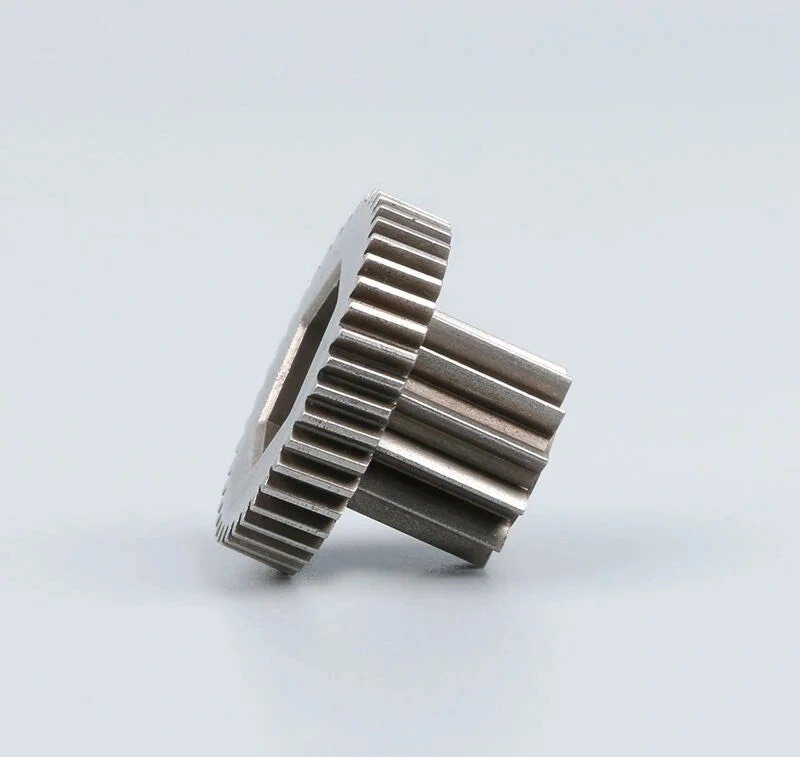
A Compound Spur Gear is a gear component that combines two or more spur gears with different diameters, tooth counts, or widths into one integrated component.
Unlike separate gears assembled onto a common shaft, a compound gear can be manufactured as a single-piece component. This integrated design can reduce the number of components in a transmission system while maintaining reliable power transmission.
The product shown above is a typical powder metallurgy Compound Spur Gear, featuring a larger spur gear integrated with a smaller-diameter gear section.
Why Use Powder Metallurgy for Compound Spur Gears?
Powder metallurgy is well suited for the production of small and medium-sized precision gear components, especially when manufacturers require consistent dimensions, complex geometries, and efficient mass production.
For a Compound Spur Gear, powder metallurgy can produce multiple functional gear sections as one component.
Key advantages include:
- Integrated construction – Multiple gear sections can be produced as one piece.
- Efficient mass production – Powder metallurgy is suitable for high-volume OEM production.
- Material flexibility – Different iron-based and alloy powder materials can be selected according to application requirements.
- Consistent dimensions – Controlled tooling and sintering processes help maintain repeatable part dimensions.
- Reduced machining requirements – The near-net-shape process can minimize secondary machining.
- Complex geometry – Gear teeth, steps, hubs, shoulders, and other features can be incorporated into the component design.
For applications requiring additional dimensional accuracy or surface characteristics, secondary operations such as sizing, machining, heat treatment, or surface finishing can also be considered.
Compound Spur Gear Manufacturing Process
The manufacturing process of a powder metallurgy Compound Spur Gear generally includes several key stages.
1. Powder Material Selection
The appropriate metal powder is selected according to the required mechanical properties, wear resistance, strength, and operating environment.
Iron-based powder materials are commonly used for powder metallurgy gears, while alloying elements can be added to achieve specific performance requirements.
2. Tooling and Compaction
Metal powder is accurately filled into a specially designed mold.
High-pressure compaction forms the powder into the basic geometry of the Compound Spur Gear, including the gear teeth, hub, shoulders, and other integrated features.
Tooling design is particularly important because the final gear geometry depends heavily on the powder compaction process.
3. Sintering
The compacted green part is heated in a controlled atmosphere below its melting temperature.
During sintering, the individual powder particles bond together, giving the component its required mechanical strength and structural integrity.
4. Secondary Operations
Depending on the application, additional processes may be used, including:
- Sizing
- Machining
- Heat treatment
- Surface treatment
- Deburring
- Cleaning
- Inspection
These processes can improve dimensional accuracy, hardness, wear resistance, and surface quality.
Advantages of an Integrated Compound Spur Gear
A major advantage of a Compound Spur Gear is its integrated construction.
Instead of manufacturing multiple gears and assembling them together, the gear structure can be designed as one component.
This can provide several benefits:
Fewer Components
An integrated gear can reduce the number of individual components required in a transmission assembly.
Simplified Assembly
With fewer separate parts, assembly operations can potentially become simpler and more efficient.
Compact Transmission Design
Combining different gear sections into one component can help engineers achieve a more compact transmission mechanism.
Consistent Gear Alignment
An integrated structure can help maintain the relative position between the different gear sections.
Cost-Effective Mass Production
For suitable applications and production volumes, powder metallurgy can provide an economical solution for manufacturing large quantities of gear components.
Applications of Compound Spur Gears
Compound Spur Gear components can be used in a wide range of mechanical transmission systems.
Typical applications include:
- Small gearboxes
- Electric motors
- Automotive components
- Power tools
- Household appliances
- Industrial machinery
- Actuators
- Pumps
- Small transmission mechanisms
- Office and automation equipment
The actual material, density, hardness, dimensions, and finishing requirements should be selected according to the operating conditions of the final application.
Custom Compound Spur Gear Manufacturing
Every transmission system has different requirements. Therefore, a Compound Spur Gear can be customized according to the customer’s engineering drawings and specifications.
Customization may include:
- Outer diameter
- Gear module
- Number of teeth
- Gear width
- Hub dimensions
- Bore diameter
- Material
- Density
- Heat treatment
- Surface treatment
- Dimensional tolerances
- Packaging requirements
For OEM projects, customers can provide a 2D drawing, 3D CAD model, sample, or detailed technical specifications.
The manufacturer can then evaluate the gear structure, powder metallurgy tooling requirements, material selection, production process, and secondary operations.
Why Choose Powder Metallurgy for Your Compound Spur Gear?
If your project requires a large quantity of small or medium-sized gear components, powder metallurgy can provide an effective balance between production efficiency, dimensional consistency, material utilization, and manufacturing cost.
A properly designed Compound Spur Gear can combine multiple gear functions into a single component while reducing the need for separate assembly.
For OEM and custom applications, the most important factors are not only the gear dimensions but also the material, density, tooth geometry, tolerances, hardness, operating load, speed, lubrication, and expected service life.
Get a Quote for Your Compound Spur Gear
Looking for a reliable Compound Spur Gear manufacturer for your OEM project?
Send us your drawings, CAD files, samples, or technical requirements.
Our team can evaluate your design and recommend a suitable powder metallurgy manufacturing process, material, secondary operation, and production solution.