
Sintering in Powder Metallurgy

Sintering in Powder Metallurgy: How Parts Gain Strength
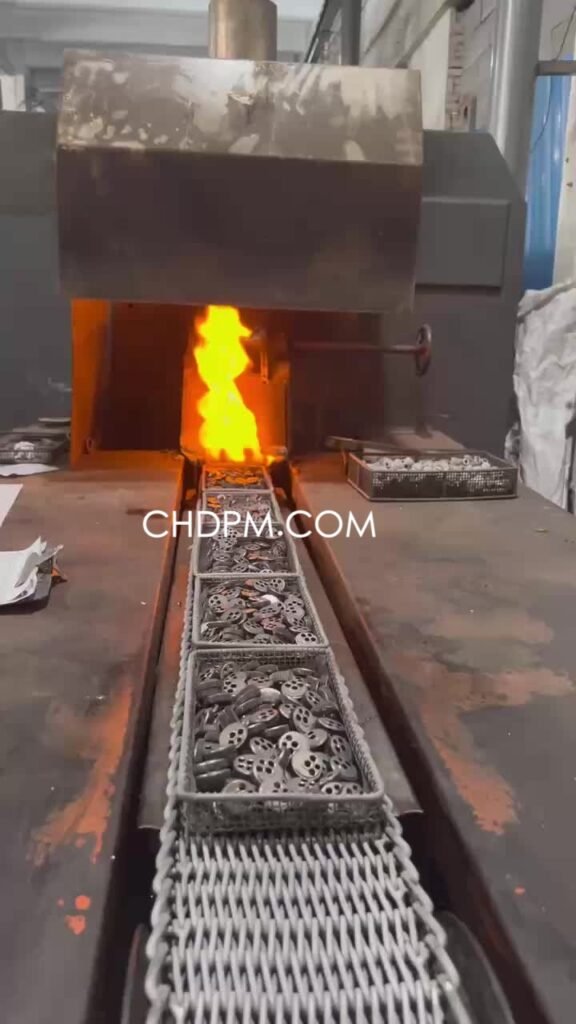
Sintering is one of the most important stages in the powder metallurgy manufacturing process. After metal powder has been compacted into the required shape, the pressed part is heated in a controlled atmosphere to bond the individual powder particles together.
Although the compacted part may already look like a finished component, it is still relatively fragile before sintering. During sintering, the particles develop metallurgical bonds, increasing the strength, hardness, dimensional stability, and overall performance of the component.
What Is Sintering?
Sintering is a controlled heating process in which a compacted powder metal part is heated to a temperature below its main melting point.
The purpose is not normally to completely melt the component. Instead, heat allows the powder particles to bond together through atomic diffusion and other metallurgical processes.
As the sintering process progresses, the contact areas between particles become stronger and the internal structure becomes more continuous. At the same time, pores within the compact may shrink and become more rounded.
The result is a stronger and more durable metal component.
Why Is Sintering Important?
Before sintering, a pressed powder-metal component is held together mainly by mechanical interlocking and compaction pressure. Its strength is therefore much lower than that of the final product.
Sintering changes this structure.
During controlled heating:
- Powder particles form metallurgical bonds.
- The strength of the component increases significantly.
- Hardness and wear resistance can improve.
- Internal porosity is reduced or modified.
- The component gains better dimensional stability.
- The final mechanical properties become more consistent.
For products such as powder metallurgy bronze bushings, gears, structural components, and other precision metal parts, sintering is essential for achieving the required performance.
How Does the Sintering Process Work?
typical sintering cycle can be divided into several stages.
1. Heating
The compacted component is gradually heated inside a controlled-atmosphere sintering furnace.
The heating rate needs to be carefully controlled. Rapid heating can cause undesirable effects such as distortion, cracking, or problems caused by residual lubricants and other additives.
2. Binder and Lubricant Removal
Some powder metallurgy components contain lubricants or processing additives used during pressing.
As the temperature increases, these materials must be removed in a controlled manner before the main sintering stage. Proper removal helps prevent contamination, cracks, or internal defects.
3. Sintering
The temperature is increased to the required sintering range and maintained for a specified period.
At this stage, atomic diffusion occurs between adjacent powder particles. The contact points between particles grow, creating stronger metallurgical connections.
This is the key stage in which the compact develops much of its final strength and structure.
4. Cooling
After the required sintering time has been completed, the components are cooled under controlled conditions.
The cooling rate and atmosphere can affect the final microstructure and mechanical properties of the material. Therefore, cooling is also an important part of the overall sintering cycle.
Video: The Sintering Process in Powder Metallurgy
Factors That Affect Sintering Quality
Sintering quality depends on several important parameters.
Sintering Temperature
Temperature is one of the most critical factors. The selected temperature must be high enough to promote diffusion and particle bonding while remaining appropriate for the material and production requirements.
Holding Time
The component needs to remain within the required temperature range for a specific period.
Insufficient holding time may result in incomplete bonding, while excessive sintering can cause unnecessary grain growth, dimensional changes, or other unwanted effects.
Atmosphere
The furnace atmosphere is extremely important.
Depending on the material, sintering may be carried out using a controlled atmosphere such as hydrogen, nitrogen, vacuum, or a specially prepared gas mixture.
A suitable atmosphere helps prevent unwanted oxidation and can influence the chemical composition and final properties of the component.
Heating and Cooling Rate
The heating and cooling rates must also be controlled.
Improper temperature changes can result in distortion, cracking, dimensional variation, or undesirable microstructures.
Sintering of Powder Metallurgy Bronze Bushings
Sintering is particularly important when manufacturing porous bronze bushings.
During production, bronze powder is compacted into the required shape and then sintered to create a mechanically bonded structure.
One important characteristic of powder metallurgy bronze bushings is their controlled porosity. After sintering, the interconnected pores can be impregnated with lubricating oil.
During operation, the oil can gradually migrate from the pores to the bearing surface, helping provide continuous lubrication.
This makes sintered bronze bushings suitable for applications where low friction, self-lubrication, and reduced maintenance are important.
Sintering vs. Melting
Sintering should not be confused with conventional melting and casting.
In casting, the metal is heated until it becomes liquid and is then poured into a mold.
In powder metallurgy, the compacted powder is normally heated to a temperature below its melting point. The particles bond primarily through diffusion while much of the original solid structure remains.
This difference gives powder metallurgy several advantages, including the ability to manufacture components with controlled porosity and complex geometries while reducing material waste.
Advantages of Controlled Sintering
A properly controlled sintering process can provide:
- High and consistent mechanical strength
- Improved wear resistance
- Controlled dimensional properties
- Repeatable production quality
- Controlled porosity
- Reduced material waste
- Efficient mass production of small and complex components
However, sintering parameters must be carefully matched to the powder composition, component geometry, density, and required properties.
Conclusion
Sintering is the critical thermal process that transforms a relatively fragile compacted powder-metal component into a functional engineering part.
By carefully controlling temperature, time, atmosphere, heating rate, and cooling conditions, manufacturers can develop the required metallurgical bonds and achieve the desired mechanical and dimensional properties.
For powder metallurgy products such as bronze bushings, sintering is especially important because it not only provides structural strength but also helps establish the controlled porous structure required for oil impregnation and self-lubricating performance.
Understanding the sintering process is therefore essential for understanding how powder metallurgy can produce reliable, precise, and efficient metal components for industrial applications.